App bMottura
Rethinking the digital experience of one of Italy’s leading lock manufacturers
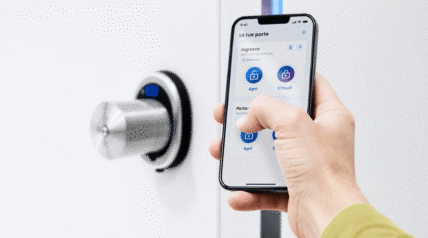
Mottura, part of the Swedish group Assa Abloy, is one of Italy’s historic security brands, with decades of experience in designing locking systems for doors and entrances. In recent years, the company has expanded its range to include smart locks fitted with Bluetooth modules, which can be controlled via a mobile app and are networked: a natural step towards transforming the physical product into a digital ecosystem.
This development has also been accompanied by a broader shift in the product vision. The aim was to build a digital ecosystem capable of delivering an experience on a par with the latest consumer IoT products.
This has meant rethinking the role of digital technology within the company, transforming it from a secondary component of the physical product into a central element of the experience.
At the same time, the project addressed a twofold business need: on the one hand, to make the product more accessible and understandable to a B2C audience; on the other, to strengthen the B2B segment by offering partners and retailers a more robust, consistent and scalable digital ecosystem. The existing app (developed natively for iOS and Android) had been part of this journey, but it carried with it the limitations of an implementation that originated in a different context: code duplication between the two platforms, a user experience that reflected the product’s internal and technical logic rather than addressing people’s actual needs, some inconsistencies between the iOS and Android versions in certain features, and limited visual consistency with the brand’s new identity.
In this context, Tangible was brought in to support the in-house team, bringing speed of execution and an external design perspective, whilst ensuring that the company’s expertise remained in-house.
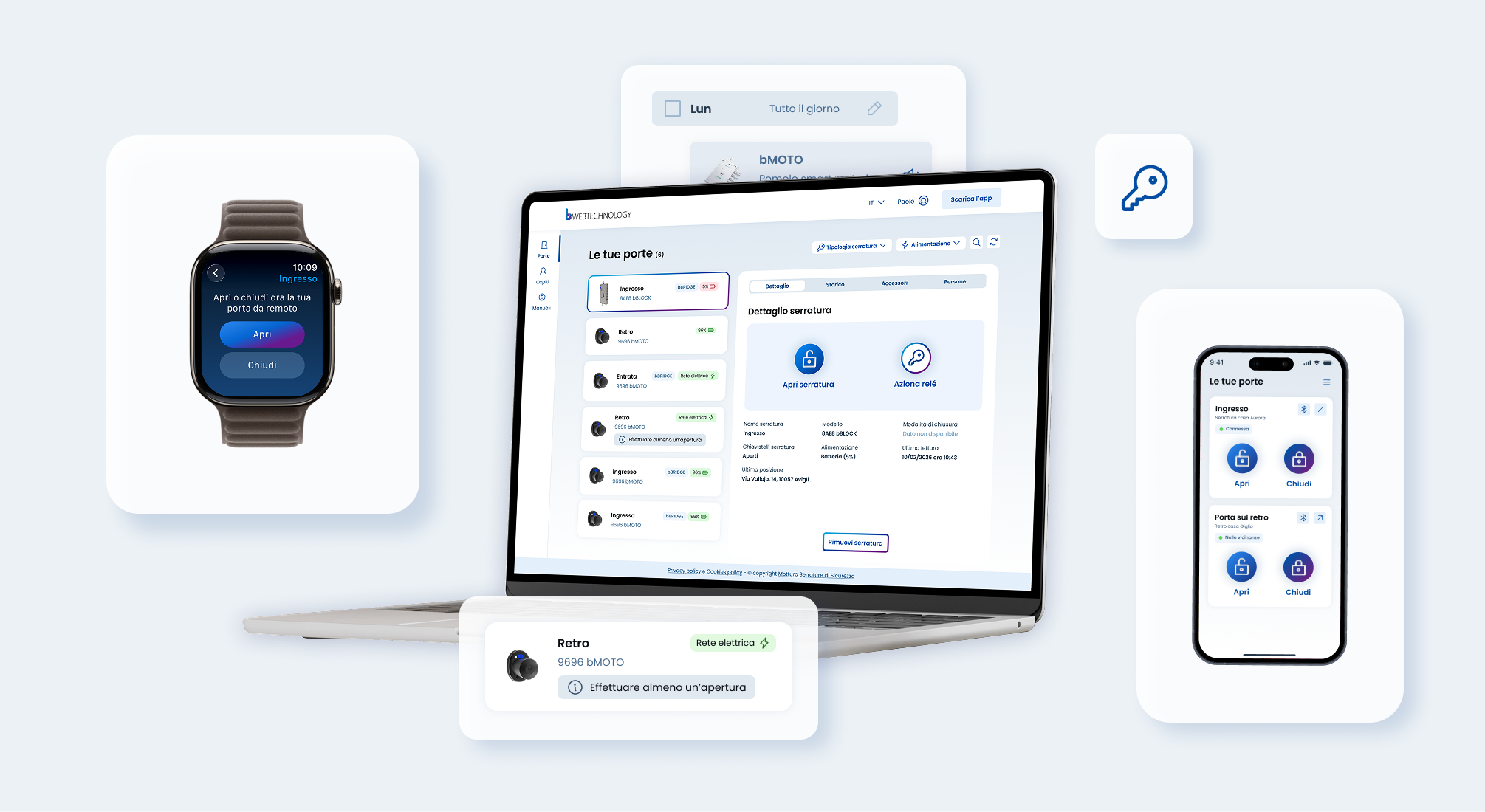
The project involved a complete redesign of the app using Flutter, with a single codebase for iOS and Android, a smoother and more modern user experience, and the foundations to support the future evolution of the product and the digital ecosystem.
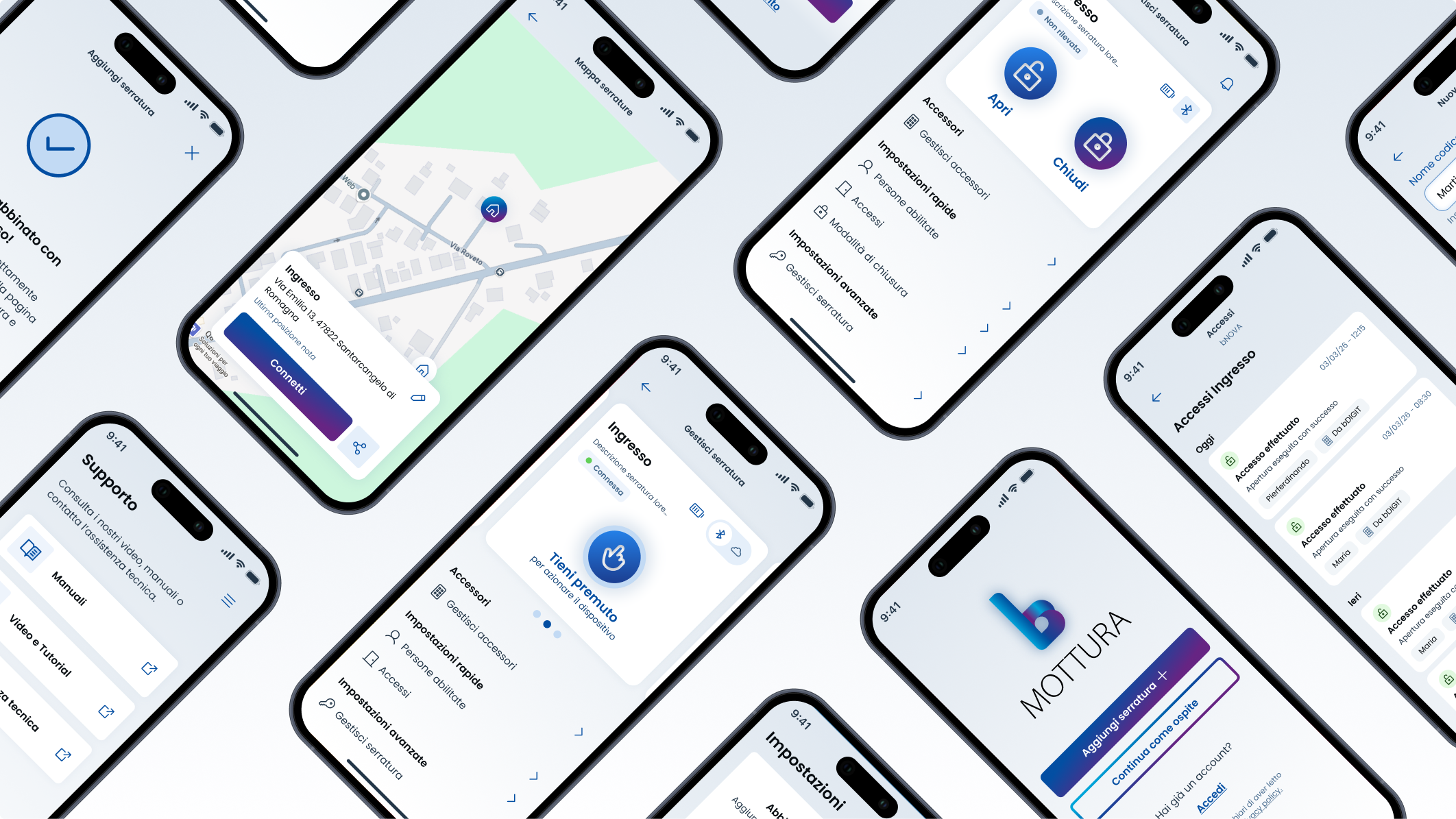
Objectives
- To design a new user experience – comprising a mobile app, a cloud-based web platform, and widgets for smartphones and smartwatches – that is more intuitive and consistent with contemporary mobile design patterns
- Migrate from a native implementation (separate iOS and Android apps) to a single Flutter codebase
- Support different user profiles with distinct permissions: owner, installer, guest
- Align the Mottura digital ecosystem (mobile app and web platform) with a consistent visual identity and interaction patterns
Main challenges
Working with strict hardware constraints
Mottura locks operate via Bluetooth, with all the limitations that this entails: communication speeds that are not always fast, potentially unstable connections, limited memory in the circuit boards, and the inability to connect multiple devices simultaneously. For the user, this complexity had to be invisible, or at the very least understandable. The design work transformed a rigid and error-prone system into an experience that feels smooth and reliable, masking the technical complexity with clear messaging and carefully crafted, guided interactions.
Inheriting product logic that cannot be redesigned
The app wasn’t built from scratch: established implementation logic was already in place in the existing code, which couldn’t be overhauled. This meant designing the user experience within existing technical constraints, finding solutions that would enhance the user experience without altering the underlying functionality. A delicate balance, which required constant negotiation between what the user wanted and what was technically feasible.
The complexity of error flows and secondary states
In a system that interacts with physical objects such as locks and fittings, the number of intermediate states and error conditions increases rapidly.
In this project, around half of the UX design work was devoted specifically to handling these scenarios: unstable connections, unrecognised accessories, offline connection forms, or incomplete configurations.
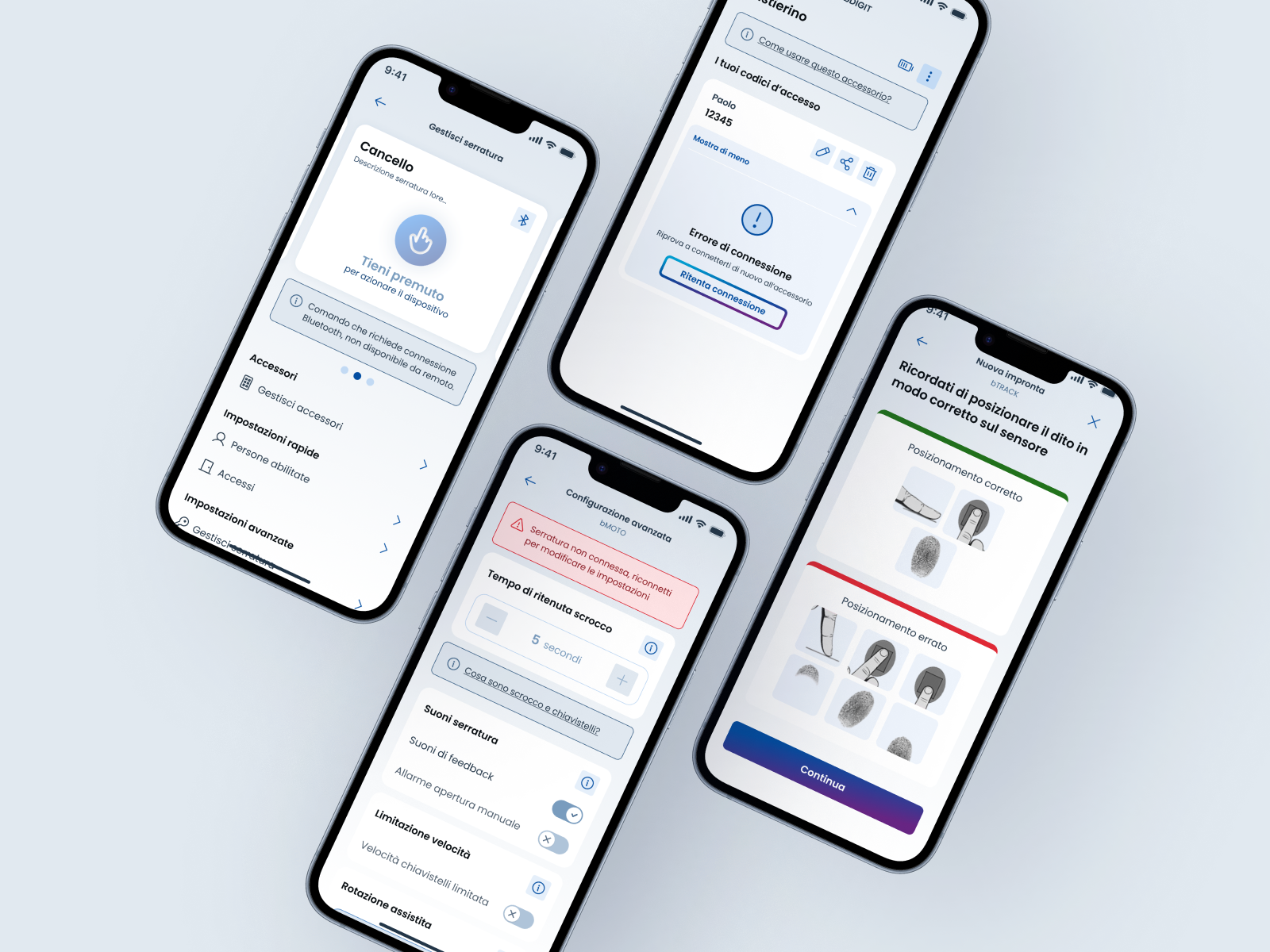
Multiple user profiles with different permissions and usage contexts
The app caters to users with very different roles and use cases: those who install the lock during the construction phase, those who subsequently become the sole administrator, and those who are granted limited access as guests or collaborators. Each profile has different permissions and operates in different contexts: either in close proximity to the lock via Bluetooth, or remotely via an additional module that connects the lock to the network.
Designing this complex system in a way that is accessible to everyone required in-depth work on information architecture and permissions management.
A distributed team working on a physical product
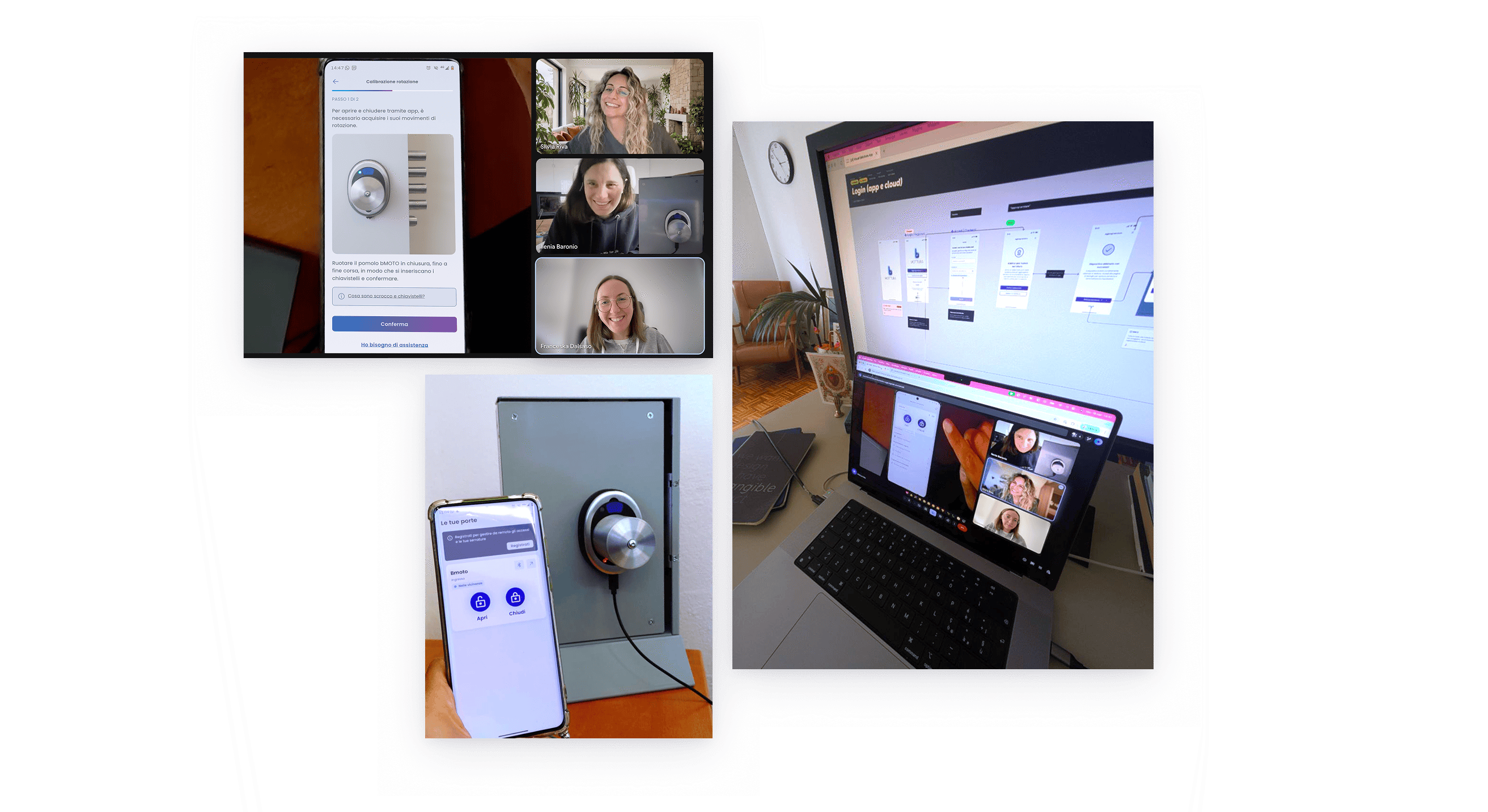
Testing the workflows of an app that controls physical locks, along with their accessories, Bluetooth functionality and hardware-specific features, without always having the devices to hand, is a real challenge. The team developed hybrid working methods to coordinate remote testing sessions, using tools such as the panoramic camera feature in macOS to share, in real time, both physical interactions with the lock and interactions via the app.
A tactical adjustment that enabled us to continue working rigorously without the need to be physically present in the same place at all times.
Collaboration with an external development partner
The project involved Quinck as a technology partner for mobile development; we aligned our working methods and communication processes with them, establishing an agile and iterative workflow that spanned everything from requirements gathering and prototype review to issue management and, finally, release.
Results
- Launch of a working MVP presented at the SICUREZZA 2025 trade fair in November, with positive feedback from both the public and trade visitors
- Presentation to Mottura sales representatives (March 2025) with very positive feedback on the user experience, reliability and visual quality of the app
- Consistent Mottura Ecosystem: for the first time, the mobile app (iOS and Android), app widgets and the bWEBTECHNOLOGY web platform all share the same visual identity and interaction patterns
- A scalable design system that supports the app’s future development and the consistency of the digital ecosystem
Process and methodology
Assessment in the absence of documentation
The project began without any written documentation on the existing app. The analysis phase was based on video footage provided by the client, a hands-on assessment of the available features, and requirements-gathering sessions with the in-house development team, gradually building up a picture of how the system actually works before we could define the design direction.
An unconventional starting point, which required the ability to analyse and summarise the information before we could even begin the design process.
Agile requirements gathering
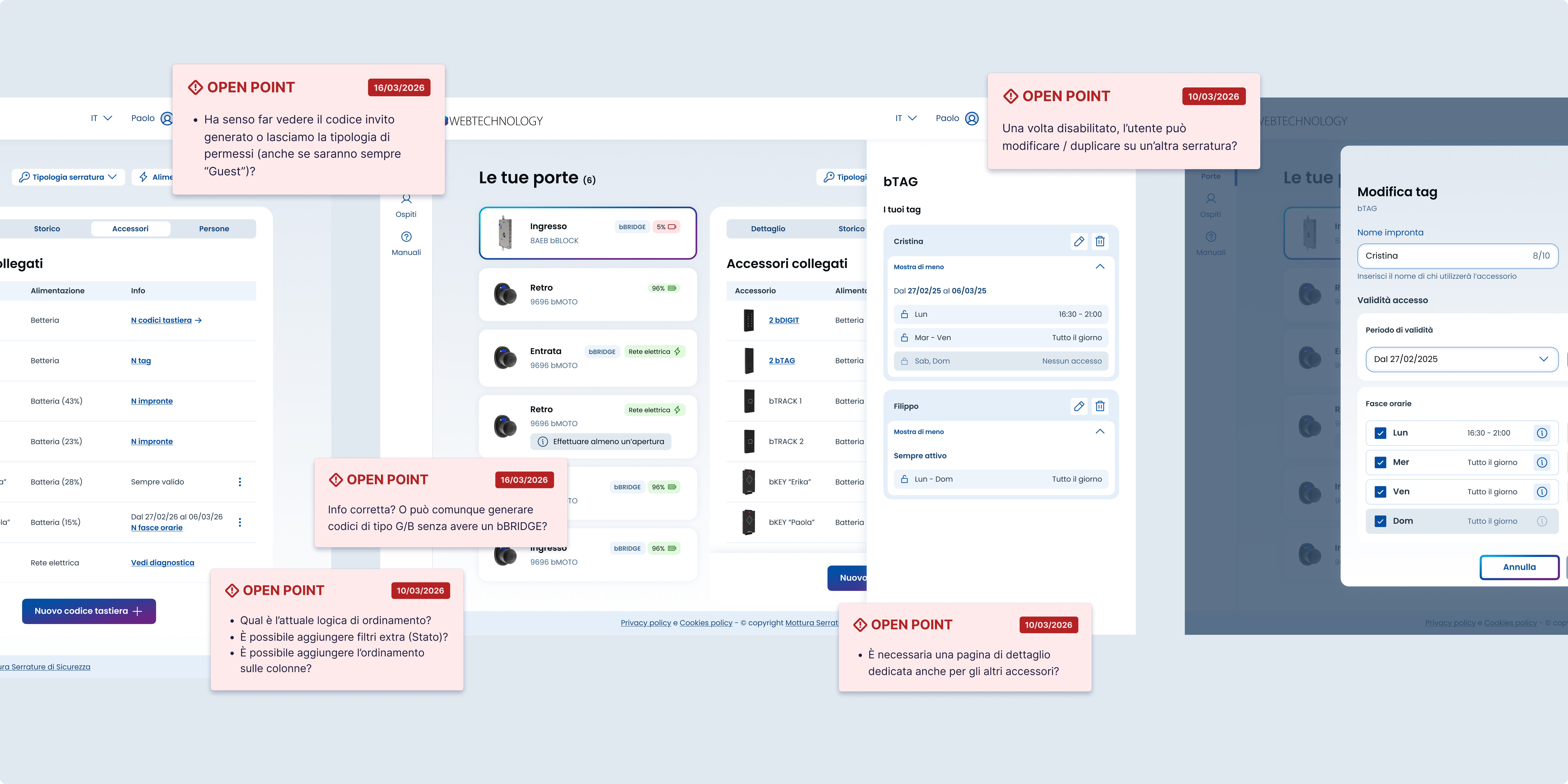
The requirements were gathered via dedicated threads, one for each feature. This enabled a continuous dialogue between design and development, documenting technical decisions, video examples and clarifications regarding the system’s behaviour.
To complement the threads, we created a dedicated FigJam file in which we mapped out the workflows that emerged, enabling us to carry out detailed and concrete comparisons of the most critical features with stakeholders and the development team.
Iterative design running in parallel with development
The project followed a highly iterative methodology, with design and development proceeding in parallel.
The design team worked simultaneously on designing new features and refining the workflows already under development, gradually incorporating error scenarios, secondary states and technical constraints that had emerged during implementation.
Design systems and ecosystem consistency
Alongside the app’s design, we worked on aligning the entire Mottura digital ecosystem.
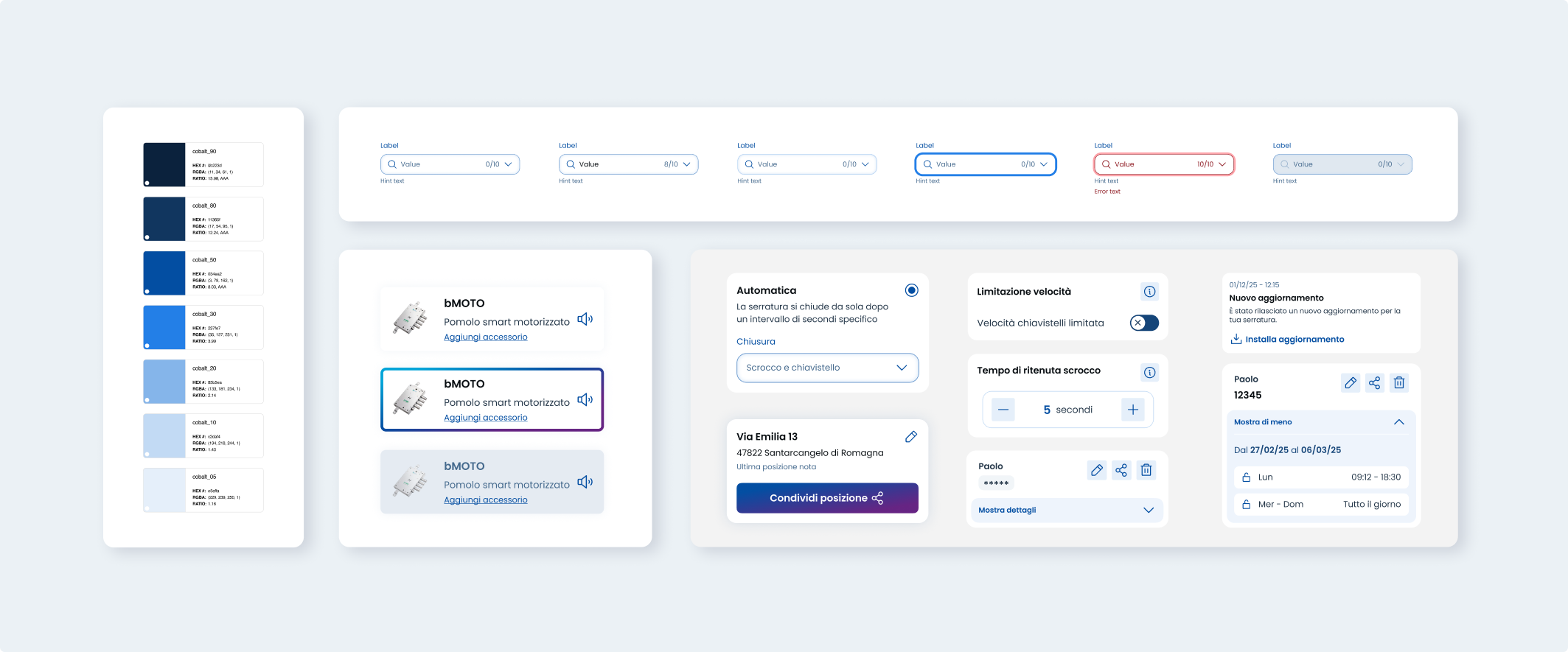
The mobile app, web platform and widgets now share the same visual design, typography and interaction mechanisms. The design system we have developed supports the evolution of the digital ecosystem, with colour tokens and reusable components that ensure consistency and flexibility over time.
Release management and feature prioritisation
In the final stages, the work involved managing the prioritisation of features (which was revised several times based on technical and business considerations) and supporting the Mottura marketing team in preparing launch materials: in-app tutorials, screenshots for app stores, and promotional assets.
A comprehensive partnership that spanned the entire product lifecycle, from design to launch.
Our collaboration with Tangible has yielded extremely positive results. The team demonstrated a great ability to listen, translating our needs into intuitive, modern solutions that were consistent with the brand’s positioning.
The move from native technologies to a hybrid framework has modernised the application, improving consistency across platforms and enhancing efficiency in the development and release of new features. The initiative has streamlined operational processes, making the experience more accessible and effective in day-to-day use.
The result is a clearer, more effective product that meets market standards, and Tangible has proven itself to be a reliable, competent and results-oriented partner.


Want more information about this project or would you like to discuss a similar project for your business?