Thinking
Impact as an ongoing practice: rethinking how we offset emissions
For several years we have voluntarily offset our carbon footprint. Over time, however, we realized that simply doing the right thing was no longer enough. In recent months we chose to evolve this approach, looking for a solution more consistent with who we are and with the territory we inhabit
This journey began in 2022, when we decided to address the topic of offsetting in a more structured and conscious way. Alongside measuring our carbon footprint, we introduced a system that allowed us to offset residual emissions and make this commitment visible externally. It was an important phase, helping us give shape to a complex topic, adopt appropriate tools, and make our commitment understandable and verifiable.
Over time, however, we realized that the model we had adopted was not fully proportionate to our size. It included tools we did not use to their full extent and made offsetting technically correct, yet detached from our daily activities. It worked on a formal level, less so in terms of understanding and narrative.
When doing the right thing is no longer enough
From there, a new phase began, defined more by questions than by answers. At Tangible, questioning is part of our method. We design digital experiences, services, and products, and we know that every design choice generates impact: on the people who will use what we create, on the organizations that will manage it, and on the broader ecosystem that hosts it.
When working with clients, we regularly ask: does this project generate shared value? Is the impact measurable? Can it be clearly communicated?
Applying these same questions to ourselves was inevitable. We asked whether it was possible to separate more clearly the measurement of our carbon footprint from the offsetting of residual emissions; whether it still made sense to rely on closed packages or if more flexible models, proportionate to our scale, existed; whether we could select projects with more legible and verifiable impact, avoiding communicative shortcuts; and, finally, whether we could do so while staying rooted in our own territory, consistent with our values of transparency and responsibility.
This led to a phase of exploration and comparison, during which we assessed different approaches, including highly structured models with significant environmental and social value. Some offered integrated solutions capable of simplifying measurement, offsetting, and communication within a single system. Others proposed compelling narratives and relevant projects.
In many cases, however, we encountered rigid models, contractual or time constraints misaligned with our size, or solutions that left little room for a genuinely conscious and proportionate choice.
Rather than searching for a “better” alternative, we understood that we needed to clarify what we were truly looking for: a way of offsetting consistent with our design approach, capable of making impact understandable, verifiable, and communicable without forcing the narrative.
An impact we can understand and communicate
Within this context, starting in 2025 we adopted a new offsetting approach. We will continue to measure our carbon footprint and offset residual emissions through certified carbon credits generated by reforestation and agricultural regeneration projects in Italy.
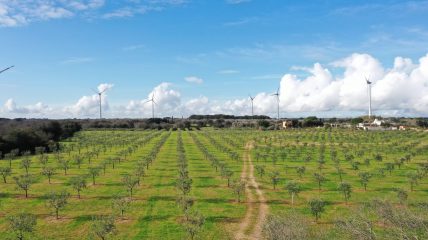
Our meeting with Carborea represented a convincing point of balance, closely linked to the nature of the projects it enables. The carbon credits are generated through reforestation and agricultural regeneration initiatives in Salento, a territory severely affected in recent years by the spread of Xylella. This crisis has impacted not only the environment but also an entire agricultural, economic, and cultural ecosystem, with profound effects on the landscape, employment, and local communities.
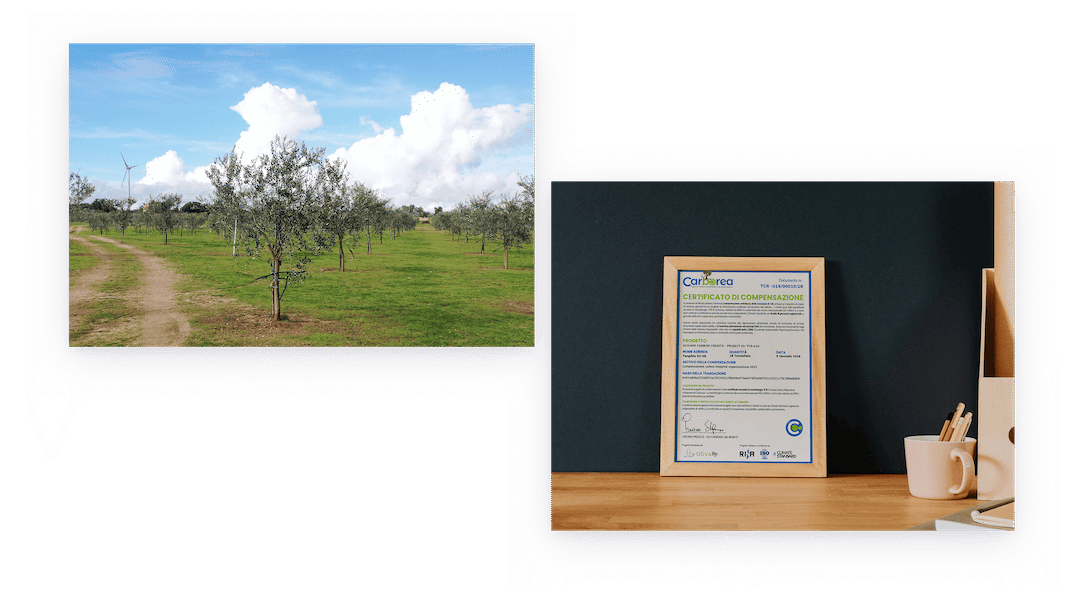
What struck us was the tangible nature of these projects. The credits are not abstract instruments, but tied to real agricultural enterprises engaged in rebuilding the territory: new plantings, restored vegetation cover, and local economies striving to recover. Methodologically, the credits are quantified and verified ex post according to recognized standards, with a level of traceability and transparency that makes the impact legible and controllable.
When we explored this project in depth, something clicked. Offsetting became a way to support an initiative with measurable environmental impact and, at the same time, social and economic value. A project we could understand, verify, and communicate with clarity, because we shared its context and meaning.
In January 2026, we offset 18 tons of CO₂ through certified Carborea carbon credits, generated by reforestation and agricultural regeneration projects in Salento. This offset covers our residual emissions for 2025 and is supported by a certificate ensuring traceability and verifiability.
Impact as an ongoing practice
Offsetting is a partial measure, to be placed within a broader path of responsibility, monitoring, and reduction.
In terms of measurement, we currently use carbon footprint as a reference to quantify greenhouse gas emissions, aware that an organization’s impact extends across other environmental and social dimensions. It is a perspective we continue to observe carefully, knowing that measurement practices themselves evolve over time.
This step represents an evolution in how we engage with the theme of impact. As with other paths undertaken in recent years, our goal is to build practices that are coherent, measurable, and capable of improvement over time.
Making impact legible means accepting complexity, avoiding simplifications, and continuing to ask questions, even when answers are not immediate. Like any design practice, this too is intended to evolve.