Thinking
Our fourth B Corp Month: continuous improvement and relationships
On December 17, 2025, we completed our B Corp recertification. Here’s what has changed over three years, both within and beyond the numbers
Every March, the B becomes visible.
But what matters happens during the other eleven months.
This year’s campaign theme is "A simple symbol, a sign of impact".
It’s an effective formula, but its meaning is not immediate. Achieving B Corp certification is a defined moment: there is a date, a score, a threshold to reach. Remaining a B Corp over time is a different kind of work.
This is our fourth B Corp Month. In 2023, we wrote about why we had become a B Corp and what it meant for us to be part of that movement. In 2024, we shared some concrete actions we had taken and a few practices that anyone could replicate. In 2025, we didn’t publish anything. Our relationship with the B Corp community had become less active, the stimuli had faded, and writing a routine post didn’t feel honest. Silence seemed better.
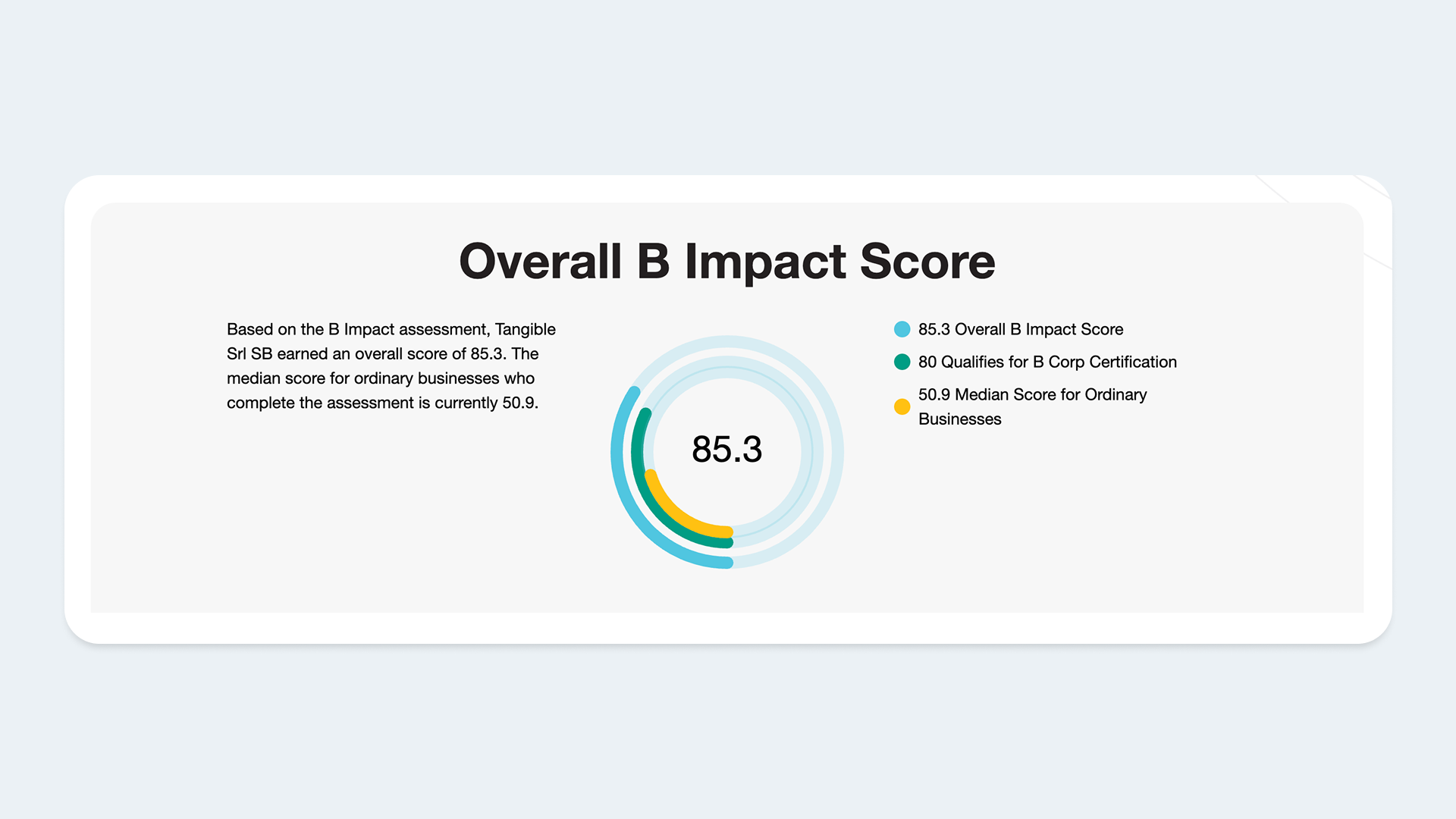
This year we return with a concrete update: on December 17, 2025, we completed our B Corp recertification with a score of 85.3.
The numbers
Compared to our first certification three years ago, we recorded an increase of 1.2 points. For those unfamiliar with the system, the minimum score required to obtain certification is 80, and maintaining it requires reassessment every three years.
It is not a spectacular jump, and we do not want to present it as such. It is an improvement built over time, in specific areas.
The most significant changes concern the “Workers” area (from 34.8 to 36.7) and “Governance” (from 16.4 to 16.9).
These improvements come from an organization that has gradually become more structured and less dependent on individual people, with impact integrated into everyday processes rather than treated as a separate topic.
Not everything has increased. And that is as it should be. Some areas remained stable, and one decreased slightly. We say this because the point is not to have a perfect report, but an honest one.
Meanwhile, B Lab’s new Standards have been published, substantially changing the structure of the certification. This is not simply a higher bar along the same path: the evaluation areas change, the structure of the requirements changes, and the way compliance is demonstrated changes. The work ahead will be different, and partly more demanding, than what we previously knew. We were already aware of this when we chose to pursue recertification.
Doing business within an ecosystem
There is a dimension of certification that does not appear in the score. One of the aspects we have come to appreciate most over time is what happens when you work with other B Corps. There is a shared language, a set of values you do not need to renegotiate from scratch each time, and a level of trust that develops more quickly because it starts from common ground.
We experienced concrete examples of this over the past year.
- With Treedom, we worked on a strategic co-design workshop aimed at defining a new platform. It was a project that required aligning management and operational teams around key decisions. Sharing a common value framework made a process smoother that, in other contexts, would have required much more time to reach alignment.
- With Piano D, the relationship is different but equally meaningful. Piano D is the technical partner we collaborate with in applying the website model we designed for Designers Italia, created for the websites of local health authorities and now adopted by organizations such as ASL Vercelli and ASL Abruzzo. We needed someone who could bring expertise we do not have internally, and we chose another B Corp. Sharing a similar approach to work reduces friction and makes collaboration more effective.
These are examples of how the B Corp ecosystem functions as a relational infrastructure: a shared ground of values and practices within which business can move with less friction.
Why we continue
We have not always agreed with every aspect of the certification. But one thing we have understood over these years is that its value does not depend on agreeing with every single point. Rather, it lies in the existence of a reference system with clear expectations—one that pushes us to reflect on our strategies, our decisions, and our daily activities.
In four years of certification we have accumulated experience. Working within a shared framework has made our processes more solid and our values more visible, strengthening our business relationships. At the same time, it has raised new questions.
For example, we realized that some requirements are calibrated for organizations very different from ours. And there are choices, such as the criteria defining who a B Corp can or cannot work with, where we have more doubts than certainties. A movement built on the idea of inclusion risks, with boundaries that are too rigid, operating through exclusion. If we believe that business can be a force for change, we should be able to accompany those who are trying to change, not only those who have already done so.
This is why today we have chosen to continue. The answers are not all clear yet, but these questions can find space within a system that is still defining its standards. Raising them openly, for us, is part of the contribution we can make.