Thinking
The product AI can't design
The product bypass: when AI lowers the cost of building, the steps you skip become the real cost.

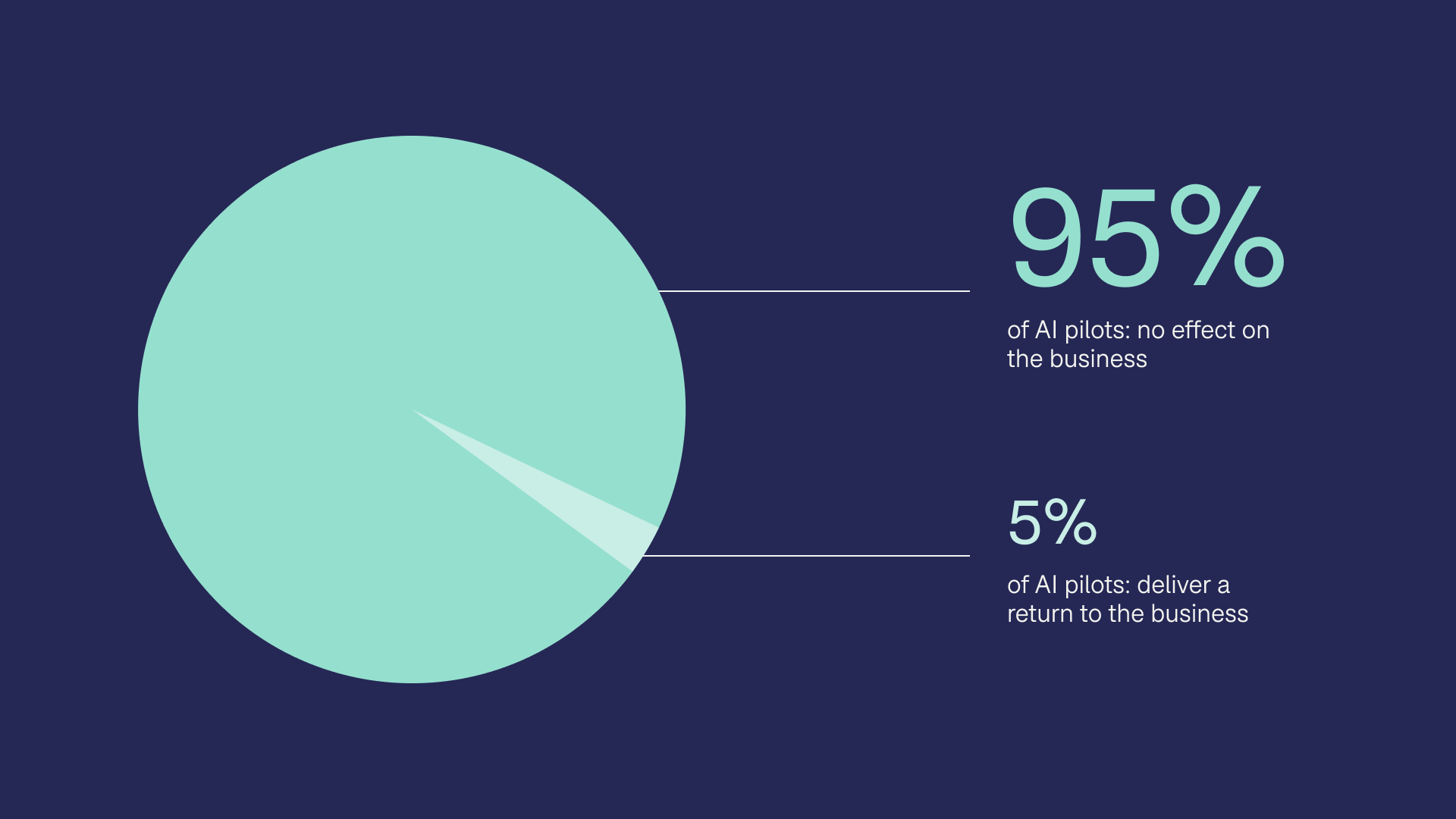
A 2025 MIT report measured the real business impact of generative AI: 95% of pilots produce no effect on the business. Not a partial return. Zero.
The finding jars with the mood we've been sensing for months, inside Tangible and beyond it. The enthusiasm is real, and understandable: the tools are powerful, accessible, and promise to change the way we work.
The easiest explanation is that the technology isn't mature yet. The truer one, according to the researchers themselves, is different: the problem isn't the models. It's that most tools don't learn from or adapt to real workflows, and so they fail to generate value in day-to-day operations.
We've seen this up close too, from a different angle.
The illusion of abundance
We were working with a company to redesign a digital tool supporting their sales process: reducing manual intervention, guiding the user's choices, and collecting data in a structured way. A defined scope, a shared direction.
Then, in one of the project calls, the client happened to mention, almost in passing, a new idea developed over the previous days using generative AI, interfaces included.
Then another, and another. It wasn't a sudden change of direction. It was a gradual expansion: new ideas arriving between one call and the next, new touchpoints to explore, new features to imagine. All of them reasonable. All of them, in the client's mind, equally urgent.
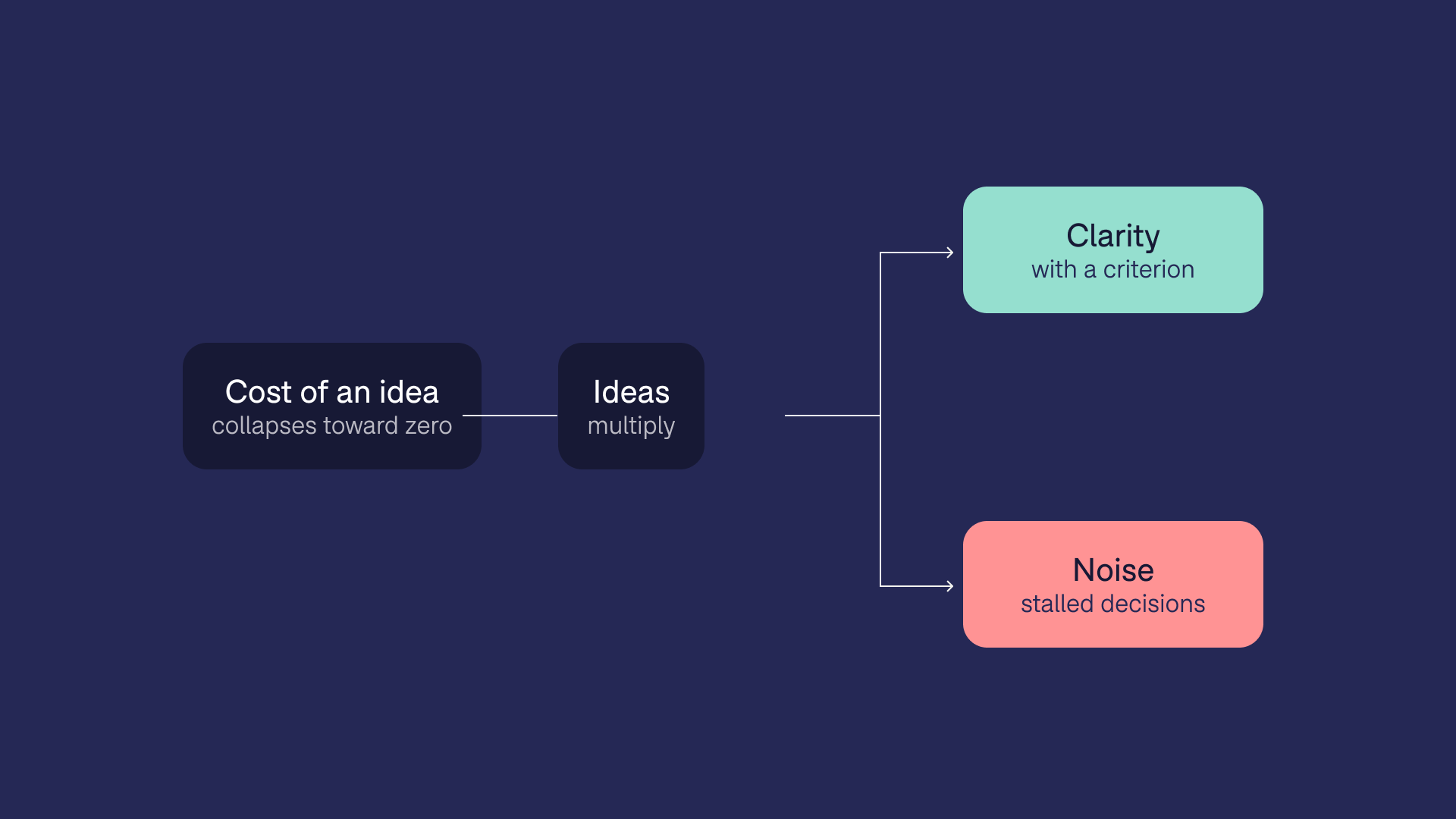
What was happening wasn't a distraction. It was something more structural. Generative AI had drastically lowered the cost of producing an idea: you no longer need to know how to build something in order to imagine and describe it.
A few seconds are enough. So why hold back?
As the ideas multiplied, we realized that the tool we were designing, the project's original starting point, wasn't necessarily the core problem. It was one piece, perhaps the most visible one, of something bigger and more tangled that the client was trying to solve in their own way: by generating idea after idea. AI had given shape and speed to a complexity that was already there. The scope had widened because the real problem had never been fully defined.
Without a method to bring order to that abundance and return to the right question, AI hadn't produced more clarity. It had produced more noise. And noise, in organizations, always comes at a cost: in time, and in decisions left hanging.
Where the bill lands
Over the past few months, we've discussed these questions with Marzia Aricò, designer and author, one of the clearest voices on the future of the profession. During a Tangible Academy session, one of her observations stayed with us:
The competitive advantage won't be doing AI, but helping clients avoid being governed by what they've built.
It's a statement that shifts the focus from adopting the tool to the designer's ability to hold a direction: being the person who helps an organization make informed decisions about what it's building.
The center of gravity in design is shifting from artifacts to decision-making infrastructure.
This shift brings new responsibilities: structuring decisions and making visible the consequences of what's being built. More than before. But also knowing when to slow things down: telling a client full of enthusiasm that some of their ideas contradict each other, and that the underlying problem still hasn't come into focus.
It's not an easy role to play. No one asks for it explicitly, and you always risk being seen as the one pumping the brakes instead of pushing forward. And yet it's often the most decisive moment. When this work doesn't happen, someone pays for it. And that cost is almost never measured in AI credits.
In our case, the cost accrued gradually: meetings kept multiplying without producing decisions, and there was no thread holding the work together. At a certain point we found ourselves asking why we were even designing, no longer convinced we were tackling the right problem in the right way.
Every AI-generated idea arrived full of enthusiasm, but without the context needed to evaluate it, none was ever discarded. None was ever truly chosen either. Decisions kept piling up, unresolved.
The conditions that were missing
What that project lacked wasn't a different tool or a more rigorous method. It lacked a question: what problem are we actually trying to solve?
Along with the question, a defined problem was missing, and so was a criterion for evaluating the ideas that kept arriving. Without that foundation, every output carried the same weight, and nothing was truly discarded. AI had made it easier to produce ideas. It had made it harder to tell which ones were worth developing. An output can look convincing in a presentation and prove useless in practice: it was the right answer to the wrong question.
A step back
As Kurt Vonnegut wrote in Player Piano: "And a step backward, after making a wrong turn, is a step in the right direction."
Going back to basics didn't mean ignoring AI. It meant recreating the conditions that would make using it worthwhile.
We helped the client establish a clear direction, thinking through the ecosystem as a whole instead of continuing to design by blindly following AI's lead. We spent weeks, real weeks, figuring out what needed to be built and validated right away, and what could wait. To do that, we found real users to test with, gathered concrete feedback, and built a shared way of working with the client's team, involving them rather than working around them.
But the hardest part of the work wasn't methodological. It was human.
Guiding the client toward a different perspective took time and constant negotiation: helping them tell what they actually knew from what they assumed they knew, convincing them to slow down before building, and giving them back a sense of the whole instead of one isolated idea at a time.
Our real work wasn't the interfaces. It was helping the client move with intention: to stop chasing every new idea and start asking which one was actually worth building.
And what about AI?
Only once there was a clear direction did AI find its real place: not as a generator of ideas to chase, but as a concrete enabler. It supported us in research and in exploring solutions, speeding up the work.
But the most unexpected value came from somewhere else. AI became a shared language with the client: visual, immediate, and accessible to both sides. What used to be almost exclusively the designer's territory (the ability to visualize an idea) is now something the client can do on their own.
This also changes the way designers and the people who live with the product communicate. The old back-and-forth of proposal and approval gives way to co-design on equal footing, where the client can express themselves and be understood.
The conditions still left to build
There's something no tool has yet learned to generate, and it isn't an interface: it's the clarity needed to decide what's truly worth building. It can't be produced in a few seconds. It's built slowly, with people. And now that building has become free, that clarity is exactly what separates a product that works in the real world from one that only works in the demo.
The question our case leaves open applies to any organization: who designs the conditions for deciding well what to build, now that building is the easy part?