Thinking
Design also means designing and facilitating dialogue and tension between functions
During the Tangible Academy, we worked on communication skills and AI upskilling. What emerged has less to do with our own relational skills and more with how we help organizations decide what to build.

Have you ever been in a meeting and realized the person across from you had stopped following? Or found yourself unable to gather all the information you needed? And maybe discovered that the right way to get it wasn't (only) a workshop?
Often it's because the person we're talking to works with different professional logic and terminology than ours. And it happens, more often than we'd like to admit, because no one in the room actually knows how the decision we're discussing will be made.
AI is shifting the weight and reshaping the form of organizations. In this constantly changing context, our role as designers of services and digital products is evolving too, moving beyond day-to-day execution and closer to the orchestration of systems, and to increasingly strategic discussions about what's actually worth building.
Communication skills play a fundamental role in all this. It becomes necessary to understand the different functions involved and their terminology, how they relate to and interact with each other, their motivations and needs. In short, the entire ecosystem design moves within today.
And what happens when a new, artificial stakeholder sits at the table, one that reasons from data and prompts?
Everything gets more complicated with AI. Design has traditionally focused on the agency, or autonomy, of the user and the client, but that's no longer enough today. Attention now extends to the agency that lives within a system made up of both people and machines. This is where the question of governance takes on a different weight, if by governance we mean everything that shapes a company's decision-making mechanisms.
How do you decide who does what? Who's responsible when the machine gets something wrong?
At this point the value of design lies in making clear what's being built, who's responsible for what, and how processes are managed, making the effects on complex business ecosystems visible. All of this so that clients can take on responsibility consciously and with full information, and it's the same reason we started working on how to design the conditions in which decisions get made, not just on what gets delivered.
It's certainly not a walk in the park. It takes a strong ability to understand a company and the roles within it, as well as the communication dynamics between the different stakeholders in play.
Managing conflict, and other lessons learned
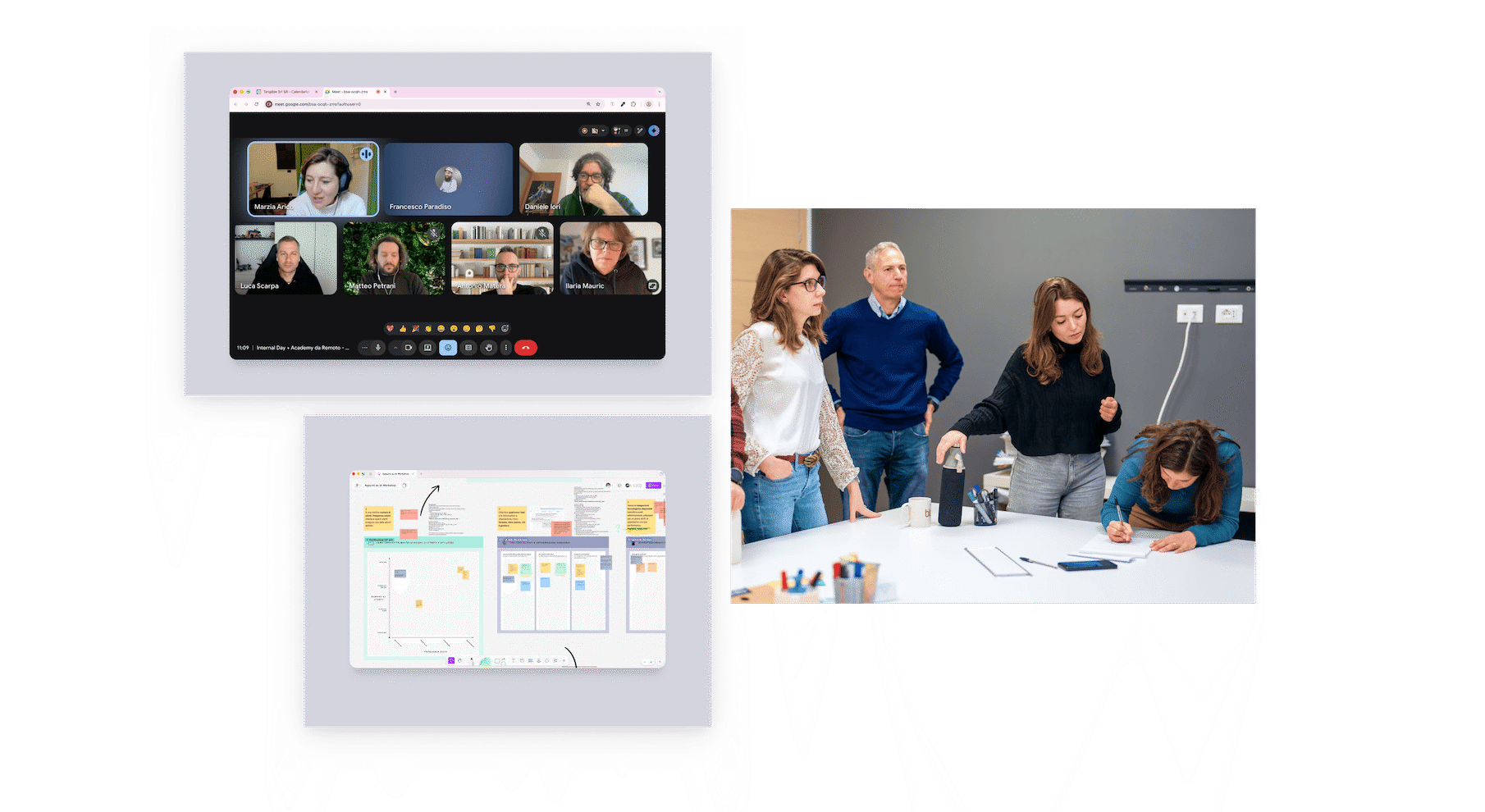
This year, among the various topics covered, the Tangible Academy chose to put the spotlight on communication skills and AI upskilling, guided by Alessandro Cravera of Newton Group and by Marzia Aricò.
With Alessandro and "Dédalus," a heart-pounding immersive learning experience, we got into the heart of communication, testing ourselves on skills like managing feedback, managing conflict, persuasion and influence. Far removed from the world of design, the narrative tracks used for training helped us understand not just how complex managing conflict and feedback really is, but that training yourself to communicate doesn't mean learning the right lines, since there's no such thing as a standard situation, but rather that what's needed is the ability to read where an exchange is heading as it happens.
With Marzia, we tried to put into practice what we'd just come to understand with Alessandro. After exploring the traits of the main roles we might encounter on the other side of a discussion table, namely Marketing, IT, Sales, HR and many others, we went through their terminology, the language that keeps them engaged, and the logic that might push them out of the room. We closed the series of sessions with a workshop simulation, to test what we'd learned and, above all, what we live through in our everyday work. Even well within our comfort zone, among colleagues, there was no shortage of friction, difficulty managing the conversation, and unexpected realizations.
Two different approaches, one thread running through both: for a designer, communication isn't the garnish on the work, it's an integral part of it. It's what decides whether you're at the decision-making table, or waiting for decisions that have already been made.
What we're taking away
The skill that stood out above all the others is reading the context as it shifts. Since standard situations don't exist, what matters is the ability to understand where an exchange is heading as it happens, and to adjust your approach accordingly.
The same goes for the tools we use to run a conversation: if the context changes during a workshop, the canvas needs to be updated on the spot, because it's a guide, not an obstacle.
Terminology varies from role to role, and choosing the right words keeps a conversation alive and stops it from losing value for the people in the room. Knowing the words, though, doesn't get you far if you don't understand that every word and every action can change what's at stake.
Naming a risk or assigning responsibility changes the context in which a decision is being made. Saying out loud what's just been said also does two things at once: it lets everyone check they've understood the same thing, and it signals to the other person the value we're placing on their words.
The most useful lesson, though, came from the friction itself. In any discussion, there are always different weights at play, some down to personality, but more often to role and organizational responsibility, and sometimes a decision gets imposed before there's time to mediate it. When that happens, it isn't always possible to get out of the impasse. What you can do is put every risk that comes with a decision made that way on the table, out loud. Awareness comes first.
But friction points to something bigger than the single meeting. When the functions involved don't have clearly stated responsibilities, the problem isn't language: what's missing is a shared decision-making model, and without one, a meeting can close, at best, with alignment.
The common thread
As the world around projects grows more complex and day-to-day work changes shape, the role of design becomes more strategic. But whether design sits at the decision-making table, or waits for decisions already made, depends on how an organization has distributed responsibility and made its decision-making mechanisms explicit.
And that's where we can work. Designing a service or a digital product today also means making the way an organization decides what to build workable in practice: which tensions between functions surface and which stay under the radar, which effects of a touchpoint no one has yet attributed to anyone.
The value of what we do is measured in exactly this: the ability to make visible where and how decisions are made, before they've already been made.