Sella Personal Credit
Bringing user voices into product decisions
Sella Personal Credit is a finance company that offers consumer credit products such as personal loans, salary-backed loans and credit cards. It operates in a regulated, competitive market, where digital products must simultaneously meet compliance requirements, business objectives and user expectations.
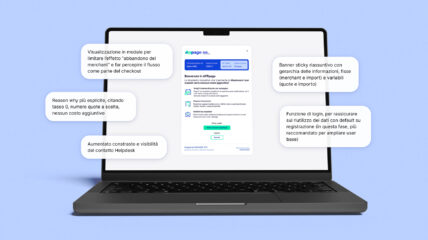
The collaboration began with AppPago, a deferred payment service offered by Sella Personal Credit, a direct competitor to solutions such as Klarna and Scalapay. Unlike the latter, which does not query credit reference agencies, every AppPago transaction generates a formal loan application that is processed via the CTC (Consortium for Credit Protection).
The initial request was limited in scope: to test the online flow, starting with a few e-commerce sites, to identify where users were encountering difficulties. Over time, this initial project led to a broader collaboration, which included structured research across the entire customer base and has resulted in new activities that are still ongoing.
Objectives
For AppPago, the aim was to improve a service that was already up and running: to identify where the flow could be made clearer and more consistent with users' actual behaviour.
The second project had a broader scope: to build a structured understanding of Sella Personal Credit's users by creating user personas - who they are, what their relationship with debt is, why they choose the company's products, and what their experience is like from their first point of contact through to the management of the relationship over time.
The ultimate aim was to create profiles representing the customer types across three of their products: personal loans, salary-backed loans and revolving credit cards.
Both shared a common direction, aimed at turning user feedback into material that can be used to inform product decisions.
Main challenges
Making qualitative research count in a data-driven context
User personas are tools designed to summarise behaviours and motivations, not to produce statistically representative data.
Integrating them into a context geared towards quantitative logic required a process of mediation in the development of outputs and the presentation of results, fostering over time a more integrated approach to decision-making that combines qualitative insights with numerical data.
Operating in a sector where the product is never stable
Regulatory changes can redesign significant parts of a flow after a project has closed. Designing the experience in the financial sector means accepting that the scope keeps shifting, often for reasons beyond the product itself.

Results
The AppPago project produced a set of operational recommendations that the development team was able to use as a reference when refining the flow, including the updates required by the new legislation.
A number of suggestions were implemented; the ongoing collaboration made it possible to keep the discussion on these topics alive afterwards too.
The Personas project provided the organisation with an understanding of its users that went beyond demographic data.
The 7 user persona profiles and the journeys produced are practical working tools, designed to support product decisions. Management showed strong interest in sharing these insights across the strategic and product departments, recognising their strategic value.
In terms of collaboration, AppPago led the way. What began as a limited usability testing project developed into an ongoing relationship: from research into user personas to new testing activities on three further products.
Process and methodology
AppPago: observing a flow in its real-world context
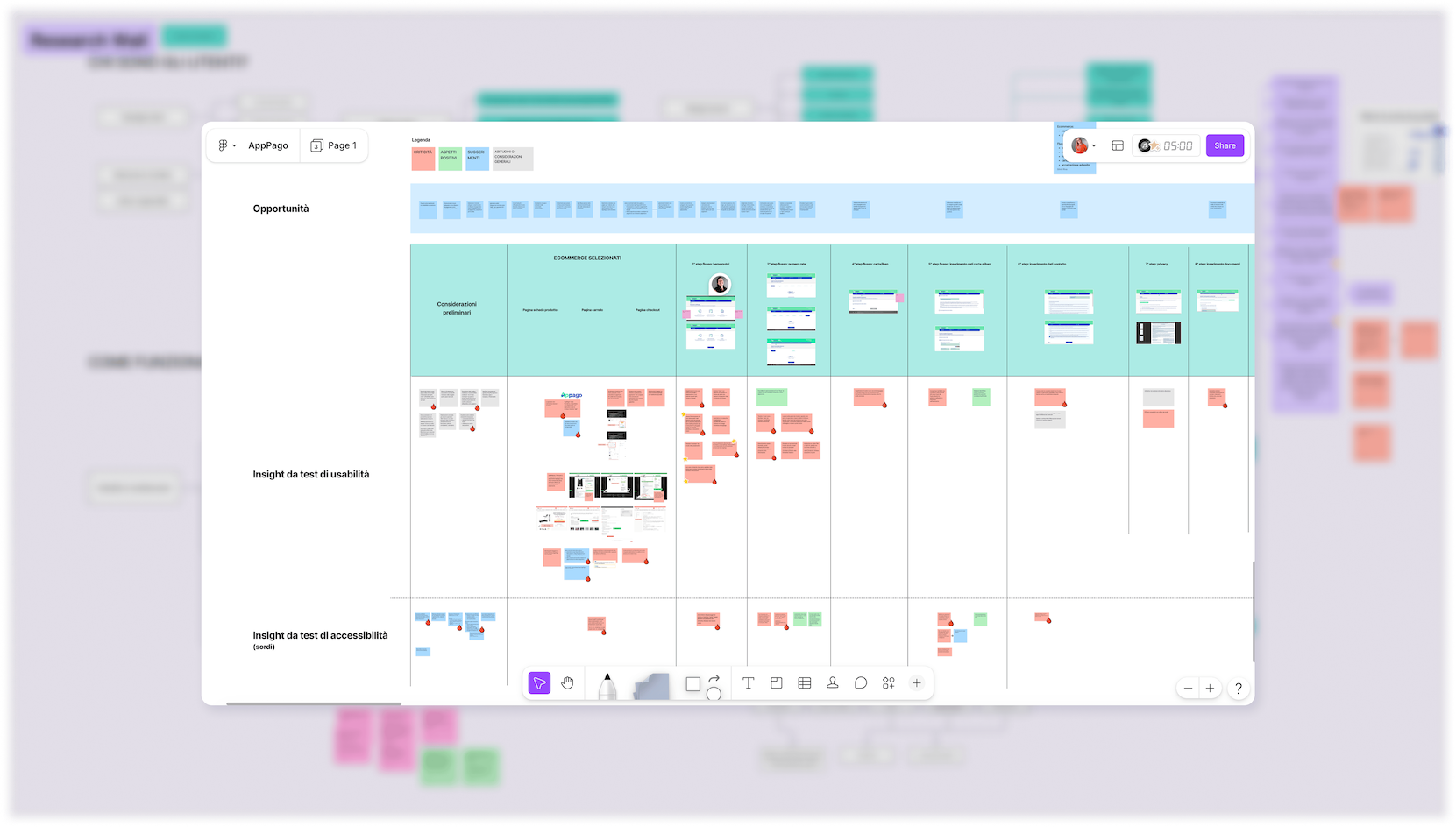
The project involved 10 usability testing sessions, conducted in realistic scenarios: users entered one of the partner e-commerce sites, chose a product and completed the payment process with AppPago. The aim was to observe how real users interacted with the flow, gathering evidence on points of friction, ambiguities in the language and critical moments in the decision-making process.
During the same working session, 3 accessibility tests were conducted with deaf users, supported by an LIS (Italian Sign Language) interpreter. Communication took place through the interpreter: questions were translated into sign language, and answers were relayed verbally. As well as producing specific accessibility insights, this part broadened the perspective on the overall service experience.
The results were presented to the client in a report setting out pain points, suggestions for improvement and a number of screenshots illustrating how the flow could be optimised. The final presentation, held in Turin, was also attended by the company's CEO and other heads of departments linked to AppPago. It was an opportunity for dialogue during which the end customer took centre stage in the discussion around their needs, challenges and future opportunities.
Being able to gather and gather and observe users’ impressions, observations and feedback in real time was a significant added value. Even when a solution is the result of careful, usability-focused design, direct input from users remains the most authoritative benchmark for assessing its effectiveness. Listening to their voice makes it possible to concretely understand how closely the design idea matches real needs, offering valuable input for continuous improvement.
Regulatory changes and their impact on the project
After the AppPago project closed, a regulatory review required significant changes to certain parts of the flow, introducing new information requirements and altering the overall experience. Some of the suggestions that emerged from the tests had already been incorporated by the development team, while others had to be reintroduced within the updated flow.
This confirmed a dynamic typical of financial products: research is never final. The product continuously adapts to external constraints, and the quality of the experience depends on the ability to remain consistent despite these changes.
For this very reason, one of the activities currently underway involves new usability tests on the updated AppPago flow.
Personas: building a structured understanding of users
The second project arose from a request by the Marketing department at Sella Personal Credit. The aim was to understand who the users of the three products are - personal loans, salary-backed loans, the Opta card - and what kind of relationship they have with the service over time.
It was the first in-depth research project commissioned by Sella Personal Credit. Before starting the user interviews, an internal alignment phase was carried out with 13 stakeholders from various corporate functions - from sales management to network support, from process management to credit and approval - and network agents.
This phase revealed something significant: the understanding of users was based almost exclusively on aggregated demographic data. The agents, on the other hand, who have direct contact with those applying for credit, knew their needs, concerns and behaviours in far greater detail.
The research was carried out on several levels:
- a preliminary research phase to gain an understanding of the domain, listening to 13 representatives from the various internal departments at Sella Personal Credit and agents
- a qualitative phase through interviews with 26 people - customers, prospects and customers of other competitors respectively - conducted both in person, at the Turin office, and remotely.
- a quantitative phase with a questionnaire that gathered around 300 responses, useful for validating and consolidating the insights that emerged from the interviews.
- A final synthesis that brought the two levels together to produce the project deliverables.
User recruitment required particular care: in a financial context, getting people involved in research without coming across as a suspicious communication is far from straightforward. The engagement emails and the telephone "script" were carefully written and tested to ensure credibility and clarity, and to instil the utmost confidence in customers.
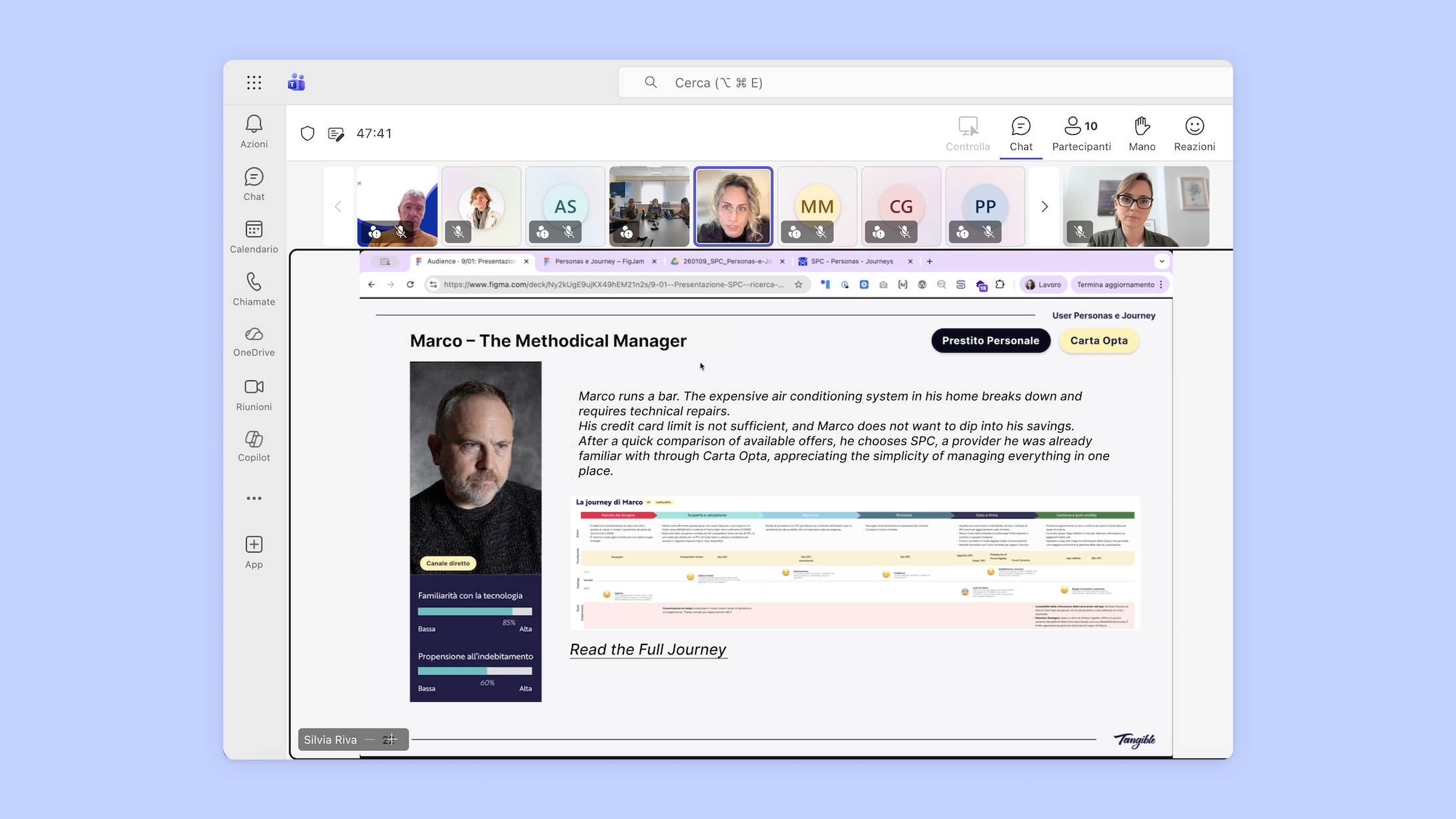
From the synthesis of the data, 7 user persona profiles were built, segmented by product, along with a series of user journeys that map the users' path from the moment a need arises through to the ongoing relationship with Sella over time.
When we launched the User Personas project, the goal was ambitious: to move beyond a reading of customers based primarily on products and to truly understand the needs, motivations and concerns of the people who choose Sella Personal Credit. Going beyond traditional segmentation logic allowed us to build a detailed picture of customers and prospects, listening to their voices and involving agents and internal stakeholders, and combining qualitative and quantitative research to bring the customers' voice into decision-making processes in a structured and measurable way. The most important value was turning intuitions and perceptions into a tool to guide product development, customer experience and communication: a concrete step towards an increasingly customer-centric company culture.
In consumer credit, friction in the user experience is not a mere inconvenience: it can lead people to give up or make the wrong decisions at times of real difficulty.
For example, one of the patterns that emerged from the research concerns a common yet little-known behaviour: when a loan application is rejected, many users resubmit it immediately, convinced it is a technical error. They are often unaware that every application triggers a new CTC credit check and that closely spaced applications accumulate on their profile, making it increasingly difficult to obtain credit in the months that follow.
One of the suggested changes concerns precisely this: making the rejection message clearer, guiding the user through the next steps on what to do or not do, thereby turning a sensitive moment into an opportunity to build trust between the user and the brand.
This is the kind of impact that comes from research done with care and with the user at the centre: not just more functional and user-friendly products, but services that help people understand what is happening at times when clarity matters most.
When we started working with Tangible, the scope was a usability test on AppPago for the e-commerce version, the first tests conducted with real customers on a Sella Personal Credit product. From there, something bigger emerged: within a few months it became the first structured research project ever carried out on our customer base.
What convinced me about Tangible was not only the quality of the work, but the ability to bring the users' voice into a sector where decisions are often driven solely by quantitative and credit-based logic. The user personas started out as a marketing tool, but the value we have seen is pushing us to bring them into product decisions too. It is not a finished journey yet, but it is the direction we want to take.





Want more information about this project or would you like to discuss a similar project for your business?